
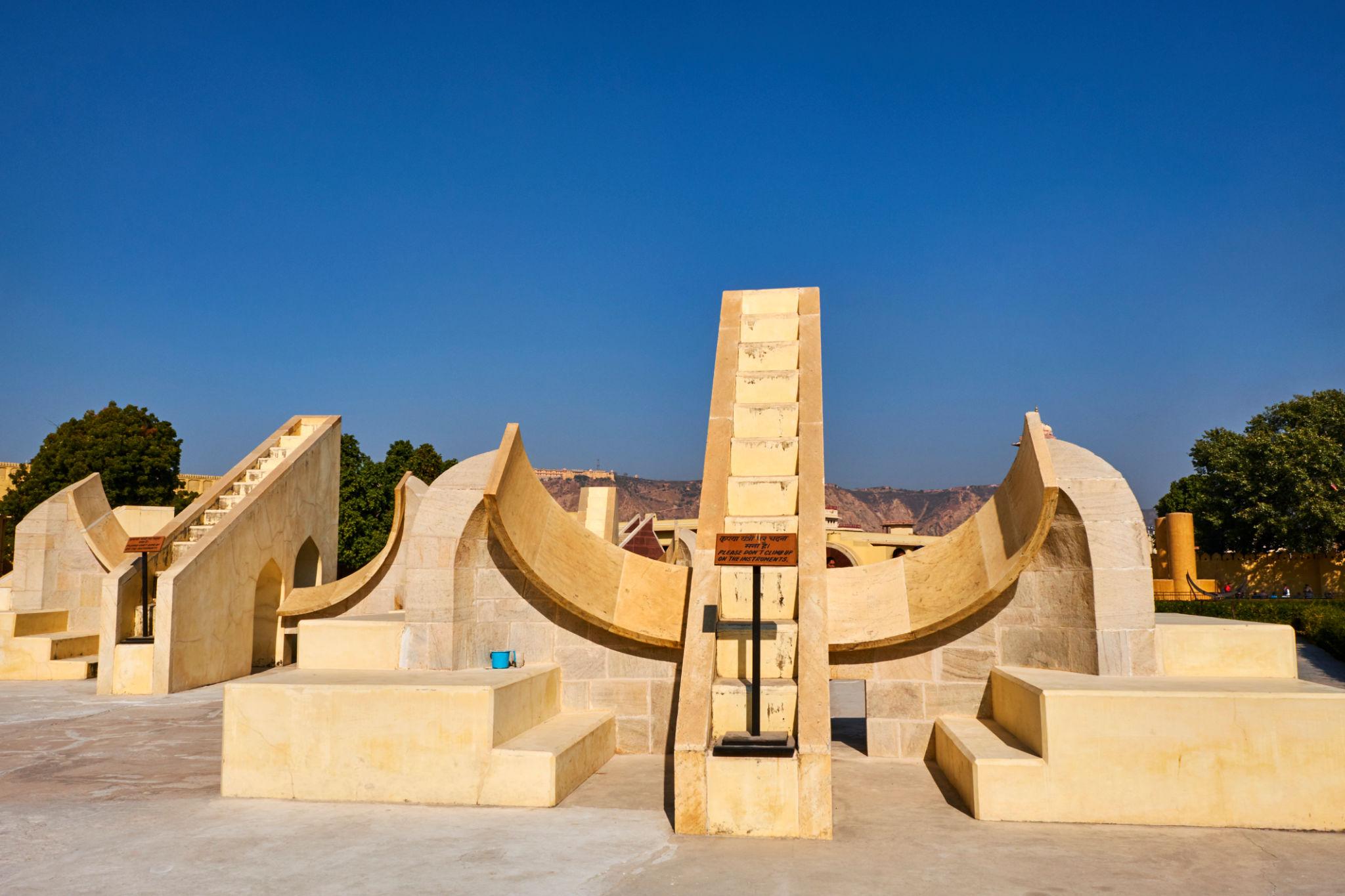
Jantar Mantar Jaipur: Quick Facts
- Timings: 9:00 AM to 4:30 PM daily
- Ticket (from 1 Jan 2026): ₹100 for Indians, ₹600 for foreign visitors; lower rates for students
- Composite pass: included in the Rajasthan composite pass (₹1,300 Indians, ₹5,500 foreigners, valid 10 days)
- Time needed: 45 minutes to 1.5 hours
- Best time: a sunny morning, so you can watch the sundials work
- Location: next to City Palace, near Tripolia Bazaar in the old city
Last checked: November 2026. Ticket prices are set by the Rajasthan Department of Archaeology and Museums and can change.
About Jantar Mantar Jaipur
Jantar Mantar is an astronomical observatory built by Maharaja Sawai Jai Singh II, the founder of Jaipur, in the 1720s and 1730s. It has about 19 large instruments made of stone, marble and brass, used to measure time, track the sun, moon and planets and predict eclipses. It is the largest of the five observatories Jai Singh built in India and the best preserved. UNESCO listed it as a World Heritage Site in 2010.
What to See at Jantar Mantar
- Vrihat Samrat Yantra: the world’s largest stone sundial, about 27 metres tall, which tells local time to about 2 seconds.
- Laghu Samrat Yantra: the smaller sundial, accurate to about 20 seconds; good for seeing how the shadow moves.
- Jai Prakash Yantra: two sunken marble hemispheres that map the sky.
- Ram Yantra: cylindrical structures used to measure the height and direction of stars.
- Rashivalaya Yantras: twelve instruments, one for each sign of the zodiac.
How to Reach Jantar Mantar
On foot: it is right next to City Palace and a few minutes’ walk from Hawa Mahal.
By metro: Badi Chaupar metro station is about 10 minutes’ walk away.
By road: autos and cabs can drop you at Tripolia Gate.
Tips for Your Visit
- Hire a licensed guide or take the audio guide; the instruments make much more sense with someone explaining them.
- Go on a sunny morning so you can see the sundials’ shadows move.
- There is little shade, so carry water and a hat.
- Combine your visit with City Palace next door and Hawa Mahal.
Jantar Mantar Jaipur FAQs
What are the Jantar Mantar Jaipur timings?
It is open every day from 9:00 AM to 4:30 PM.
What is the Jantar Mantar ticket price in 2026?
From 1 January 2026 the ticket is ₹100 for Indian visitors and ₹600 for foreign visitors. Students pay less with a valid ID.
What is the Samrat Yantra?
The Vrihat Samrat Yantra is the world’s largest stone sundial, about 27 metres tall. Its shadow tells local time to about 2 seconds.
Who built Jantar Mantar in Jaipur?
Maharaja Sawai Jai Singh II, the founder of Jaipur, built it in the 1720s and 1730s.
Is Jantar Mantar a UNESCO World Heritage Site?
Yes. UNESCO listed it in 2010.
How much time do I need at Jantar Mantar?
Plan 45 minutes to 1.5 hours, longer if you take a guide.
Discover the fascinating world of astronomy and science with our Jantar Mantar Jaipur Tour by Unmap Adventure. Visit one of Jaipur’s most remarkable historical attractions and explore the impressive astronomical instruments built by Maharaja Sawai Jai Singh II.
Jantar Mantar is a UNESCO World Heritage Site known for its unique stone and masonry instruments used to observe celestial movements and measure time. This experience is ideal for history lovers, architecture enthusiasts, students and travellers interested in India’s scientific heritage.
Explore the fascinating instruments, learn about traditional astronomy and discover an important part of Jaipur’s royal history.
Tour Highlights
• Explore the UNESCO World Heritage Site of Jantar Mantar.
• Discover the world’s largest stone sundial, Samrat Yantra.
• Learn about traditional Indian astronomy and timekeeping.
• See fascinating astronomical instruments and structures.
• Understand the scientific vision of Maharaja Sawai Jai Singh II.
• Enjoy photography of the historic architecture.
Places and Attractions to Explore
1. Samrat Yantra
Discover the impressive Samrat Yantra, a giant sundial designed to measure local time using the movement of the sun.
2. Jai Prakash Yantra
Explore the unique bowl-shaped instruments used for observing celestial positions and understanding astronomical movements.
3. Ram Yantra
Learn how these instruments were designed to measure the altitude and direction of celestial objects.
4. Other Astronomical Instruments
Discover the different structures at Jantar Mantar and understand their historical role in astronomy.
Why Visit Jantar Mantar with Unmap Adventure?
• Discover Jaipur’s scientific and cultural heritage.
• Learn about historic astronomical discoveries.
• Explore a UNESCO World Heritage attraction.
• Suitable for families, students and history enthusiasts.
• Combine your visit with other famous Jaipur sightseeing attractions.
Important Information
• Destination: Jantar Mantar, Jaipur, Rajasthan, India.
• Tour Type: Heritage and sightseeing experience.
• Suitable For: Families, couples, students and history lovers.
• Recommended Visit: Morning or afternoon, subject to opening hours and weather.
• Entry Tickets: Check the applicable entry fees before visiting.
• Guide Service: Subject to availability and package arrangements.
Book Your Jantar Mantar Jaipur Tour
Explore the fascinating connection between science, history and architecture at Jantar Mantar Jaipur with Unmap Adventure.
Plan your visit and discover one of India’s most remarkable astronomical heritage sites.
Explore History. Discover Science. Experience Jaipur with Unmap Adventure!